Lot of things happened in last two weeks and I am now in UTD for my phd. I applied for visa more than two months ago. My wife was refused spouse visa and I was referred to security clearance. I was waiting for the security clearance to come. Almost all who applied for visa at the same time got their security clearance. My orientation date was 14th August. I was losing hope and at one stage gave up the hope completely. But dramatically, on the 8th August it came. I only had a handful of days to prepare and fly. After much struggle, I got one expensive ticket to Dallas of British Airways. I flied on the 14th and reached Richardson on the 15th. My friend Arif and his wife came to receive me. I attended the late orientation on the 17th.
There are lots of things to tell among these events. If I start in detail it will take so long that my fingers will start aching. So, I think I should skip most of them and just tell how much I miss my family, my home and my country. I was feeling so bad in the flight from London to Los Angeles that I decided to get back to country after one week. I miss my family terribly. I realized how sweet one's motherland is after leaving it. No country, regardless of how rich, developed it is, is comparable to one's motherland. I am dying for the moment I will be again in my country. I am staying with a fellow Bangladeshi here who is really a good person. I am fortunate to get a Bangladeshi roommate. My friend Arif and his wife are helping me a lot. I am very grateful to them for arranging everything for me before I arrived here. My class has begun on the 17th. The load will increase gradually. As I am a TA here, I will have to do a lot of TA works too. One of them has already begun. I already told my professor that I will go to Bangladesh after this semester. He is a nice man too. He did not disagree.
I hope I will be able to fulfil the purpose for which I came here though I will not be happy here without my family. After I get the degree, I will get back to Bangladesh, my sweet home country.
Tuesday, August 22, 2006


Saturday, August 05, 2006
Amazing!!! 19 downloads in two weeks!!!
Since I uploaded the TrayController project to SourceForge.net, the installers have been downloaded 19 times. Isn't it cool? I am very excited and happy to see this. I really did not expect that much. I hope the software is being used by the downloaders. I am yet to receive any feedback from users. I will be happier to get some suggestions, comments or bug reports from the users.
Wednesday, August 02, 2006
An excellent criticism of Java
This is by far the best article by Joel Spolsky I have ever read. While reading the article, I wondered whether he read my thoughts before writing it or not. The points he made are very valid and I can no more agree with him. I have been long looking for this kind of articles in the net which will support my view unequivocally. I am sure that some of my ardent java fan friends will be hurt by it, but what he wrote is fact no fiction. I cannot like Pointer-less programming languages for the reasons mentioned in it. C++ is the best (as suggested by the poll in the right side too :-) ), no doubt about it. It is so much powerful and flexible that one can do anything (s)he likes. Chopping off the head to get rid of headache is not any solution. But unfortunately, popular programming languages like Java and C# have done exactly that by leaving out pointers. I was always a fan of Joel's articles but today I have become a bigger fan :-). Sorry Java-lovers ;-).
Sunday, July 30, 2006
My first open source project
I created my first open source project in sourceforge.net. It is an application which ejects and closes trays of available CDROMs and DVDROMs. Actually, the idea came to my mind because I needed such an application. My fancy CPU casing adds extra button on the drives' eject/close button. For that it became hard for me to open and close them as the buttons are not of good quality. Closing the trays are even harder as the tray hides the button when ejected. So I needed some kind of software control. Trays can be ejected through windows explorer but they can't be closed. My application adds an icon in shell notification area (the one where the clock resides). Right-clicking the icon opens a menu through which trays can be ejected and closed. Left double clicking also opens a window through which the same things can be done. The application is started when windows starts. I have licensed the project with GPL. So, downloading binary/codes, editing, using etc. all are free. I have not build the homepage of the project yet. But the svn repository can be accessed via the URI: svn://svn.sourceforge.net/svnroot/traycontroller/code/trunk. The files can be viewed by browser through this URL: http://svn.sourceforge.net/viewvc/traycontroller . I will try to add a nice page in the homepage location soon. I am very excited about my first open source project. It will be very nice if someone really uses it. Any contribution is very welcome. I will be very happy if I get any comments, feature requests or any kind of feedback. Hope, I will be able to build more open source software in future which will be more useful to people.
Saturday, July 15, 2006

Wednesday, July 12, 2006
A BOLD ARTICLE
I loved every bit of it. This kind of explicit article is very much needed to unveil the masquerades of the corrupt politicians. I thank wholeheartedly whoever posted the article. It should reach the mass people of our country who are perpetually being robbed and deceived by these swindlers. More people should come up with such stories. We are badly in need of a corruption free country.
Tuesday, July 11, 2006
ZIDANE in Action: A Hilarious Stuff
Visit here and must click the mouse :D:D:D.
However, I feel sorry for him. His end should not be such a tragedy. A great hero he is!
However, I feel sorry for him. His end should not be such a tragedy. A great hero he is!
Sunday, July 09, 2006
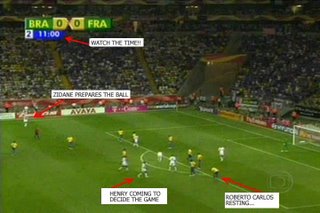
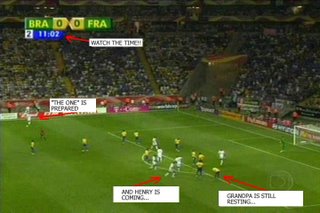
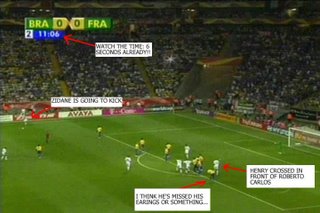
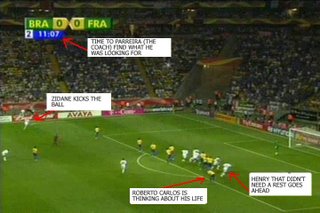
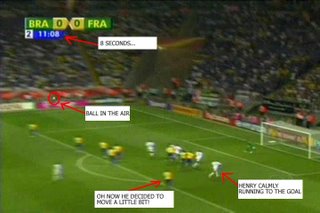
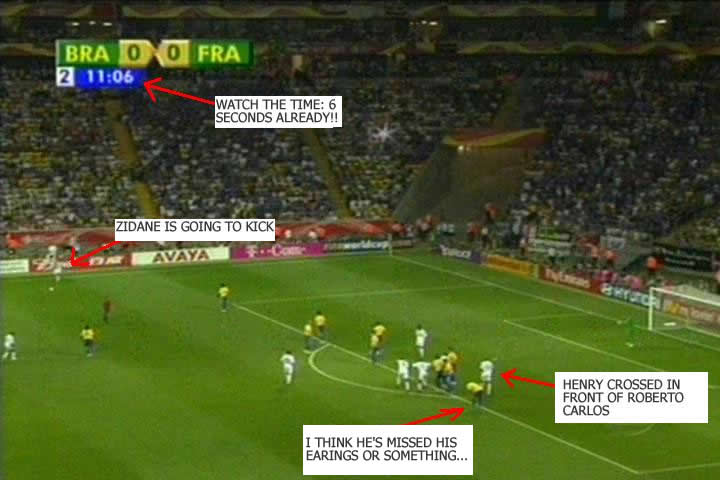
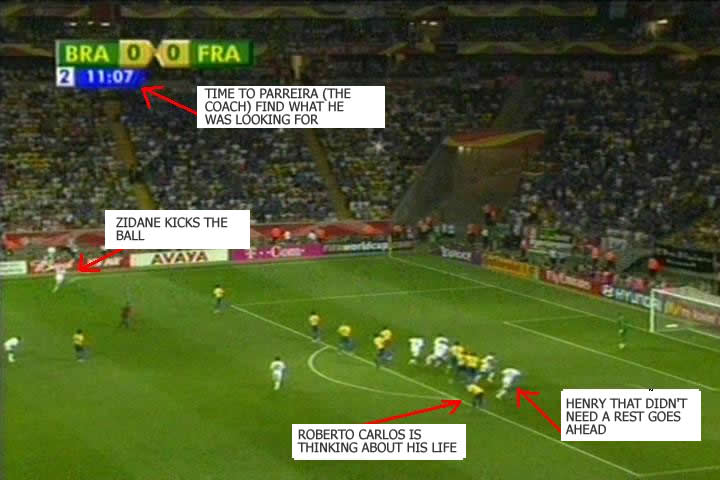
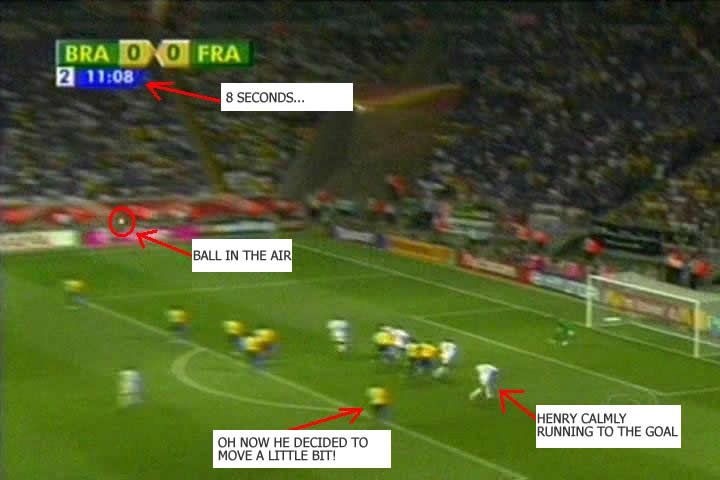
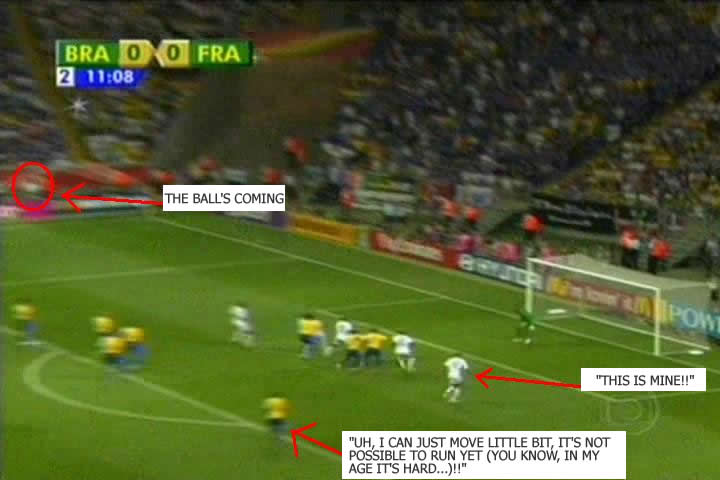
How Brazil Lost, An Analysis
I got this from a friend. An excellent analysis. It supports my view. The inclusion of aged players by the coach ruined Brazil's chances this year.





Tuesday, July 04, 2006
SAMS Reference Library
SAMS publishing has provided online html copies of some of its books. They are calling it Reference Library. Entire books can be found here. Most of the books are old, may be not much needed these days. But people who really need them can be benefited by the library as these books are almost out of the market now. I think it is a good move by SAMS to benefit the readers.
Sunday, July 02, 2006
Shame on Parreira!!!
Parreira is the only person to blame. I wonder how a person not fields his best team and still stays as coach. He killed Brazil's chances even before the tournament by being the coach. Shame on him!!! Shame on Cafu and Roberto Carlos who selfishly stayed in the team whereas they should have retired to provide opportunities to brilliant youngsters like Cicinho. Shame on Ronaldo, Ronaldinho and Kaka! They should concentrate more on their clubs to earn millions. Because that's where they belong. The good news for Brazil is Parreira, Cafu and Carlos will no longer be burden of next Brazil world cup team.
Saturday, June 24, 2006
World Cup Blog
World cup blog is a great site for world cup 2006. I liked it more than the official FIFA site. In fact, it is far better than that in terms of content. Yahoo did not do a good job in the official site. It seems boring to me. The interface is too crowded and the content is poor and short. The BBC world cup site is a good one. Its look is same as its other pages, they did not use any different template. But the content is better than the official site. It also provided some user feedback option, much like discussion forum. Among these three the blog site is the best. I am getting news as well as people's views here. There are photos, fixture, score sheets, virtually everything. I regret not to find it early. Anyone, who wants to read a lot about world cup, can visit this site.
Wednesday, June 21, 2006
New Chip Breaks Speed Record
Researchers at I.B.M. and the Georgia Institute of Technology are announced that they have broken the speed record for silicon-based chips with a semiconductor that operates 250 times faster than chips commonly used today.The achievement is a major step in the evolution of computer semiconductor technology that could eventually lead to faster networks and more powerful electronics at lower prices, said Bernard Meyerson, vice president and chief technologist in I.B.M.'s systems and technology group. He said developments like this one typically found their way into commercial products in 12 to 24 months. At 500 gigahertz, the technology is 250 times faster than chips in today's cellphones, which operate at 2 gigahertz. At room temperature, the chips operate at 350 gigahertz, far faster than other chips in commercial use today. I think it is a major breakthrough in semiconductor technology. It was really heard that silicon chips are reaching their limit and optical technology will replace them. But it seems that silicon chips will live longer than expected. The news can be read here.
Monday, June 19, 2006
Joel Spolsky writes on his first experience with Bill Gates' review
This is another mind-boggling article from Joel Spolsky. I liked both the date-time thing and Bill Gates' review part. The date-time part was funny. And the review was funny too but at the same time it provided some valuable insight on how technical Bill Gates is. People used to think that he is just an executive who oversees business leaving all the technical stuff for his subordinates. I am really impressed to see how active he was to read a long review with taking into account every details in only one night. He must be as good in technical side as in business. I also can't agree more with Joel on that a software company should be led by technical people not some MBA type people.
Tuesday, June 06, 2006
Nuclear Energy: Only solution to our power crisis
Nuclear energy is the only medicament to our ongoing horrible power crisis. It is best both for short term and long term solution. Building many power plants for small production like 200, 250, 400 MW is no more a solution for our country. We build few and more power plant phases out at the same time. As a rapidly developing country, our energy need is growing each day too. So, there is always a gap and that gap is widening. Furthermore, looking not so far in future, fossil fuel is limited in quantity, it will be depleted some day. We will face trouble even before that when the fuel will become dearer. So, it is right time to set up a nuclear power plant. We are long holding a site to build one. We must start building it now. I think we can seek complete help from U.S. They will be costly, but they will provide the most reliable and easy and cheap to maintain technology. Foreign minister sought help from China in this regard. I think government is looking for cheap technology. But building a nuclear power plant will be very costly in any way. So, we have to spend it. But we can spend some extra bucks to get the desired reliability and cheap easy maintenance. The extra money will also be huge, but it is worth it keeping in mind that we have to spend the huge amount only once. Spending big amount initially is certainly better than spending less and then spend every now and then just to keep poor things running. The only thing I am concerned about is whether U.S. will like to help us in this regard or not.
A miracle opportunity for Bangladesh
Right after connecting to SEA-ME-WEA-4, Bangladesh has got a rare opportunity to join another consortium. The new consortium is led by Telecom Malaysia and includes seven countries at this moment. It will lay a cable which will connect south east Asia with U.S.A. The new cable is named Asia-America Gateway or AAG in short. Bangladesh, if acts wisely and promptly, can join this consortium. It will give it a much needed backup to SEA-ME-WEA-4. Currently, the ISPs have to maintain their old vsats just for backup purpose which is not lowering the cost of internet. The new cable will give us huge bandwidth along with the much needed backup. I think, it is a must for Bangladesh to join this consortium. The ruling party must forget its any mean political and financial interest and decide to avail the marvelous opportunity. Otherwise the sad history of 90's will repeat.
Source: http://www.thedailystar.net/2006/06/06/d6060601033.htm
Source: http://www.thedailystar.net/2006/06/06/d6060601033.htm
Friday, June 02, 2006
An amazing revenge
This is the most spectacular revenge story I heard any time soon. Amir Massoud Tofangsazan, a con man, thought himself very smart which he actually was not. He sold an out of order laptop by eBay for £375 to Thomas Sawyer, a 23-year-old student. He thought he would get away with it as he did with Debbie McInerney by selling an iPod, which never really reached her. But I think it was the greatest mistake of his life to underestimate Thomas Sawyer and turn down his pleas to refund. In retaliation, Thomas set up a blog about the incident. It is a mocking first-person account which brought fantastic result. When I visited it, the hit counter was showing 2655821!!! This proves that Thomas avenged the fraud with overwhelming success. The anguished Amir told the Daily Mail that the website had made his life a "living hell". The real good news is that police is currently investigating the incident. It is one of the smartest revenges I have ever heard of. So, blogs have found one more use: to take tormenting revenges!!! Thanks Thomas for the novel idea!
Monday, May 15, 2006
An Open Source Scientific Library/Database in C++
Code Cogs is a great site for open source code library in C++. It is the only of this kind in the world. Its intention is to provide open source efficient solutions of mathematics, statistics, science, engineering and finance. It has some excellent notable libraries. Anyone can contribute and be benefited from it.
3D Desktop
3D desktop is a great idea I came across today. I was happy to find that many works are going on it. I found few interesting screenshots of some such works. The most impressive work on it seemed to me Project Looking Glass of Sun Microsystems. It is an open platform to explore innovative 3D user interface. Here is a cool screenshot below:
 Though the screenshot is beautiful, I am not much excited about this project. I have experienced sluggish behavior of Java desktop of Solaris 10. Due to this experience, I don't think this desktop environment will be as much responsive as it should be.
There are some programs in Linux which gives 3D effect to desktop using OpenGL e.g. XGL. But I did not find them impressive. They have a long way to go.
In Windows world, Windows Vista and Windows Presentation Foundation API promise to give a new look and feel of the desktop. But why should we wait so long? There is already a great implementation SphereXP. It displays icons and windows inside a sphere instead of a flat desktop hence providing 3D environment. Here is a screenshot of it:

So, 3D desktop is not far away. Though our display devices are going to be 2D for quite a long time, our desktop is going to be 3D for sure. I am certain that it will bring some fantastic and rich experience to us.
 Though the screenshot is beautiful, I am not much excited about this project. I have experienced sluggish behavior of Java desktop of Solaris 10. Due to this experience, I don't think this desktop environment will be as much responsive as it should be.
There are some programs in Linux which gives 3D effect to desktop using OpenGL e.g. XGL. But I did not find them impressive. They have a long way to go.
In Windows world, Windows Vista and Windows Presentation Foundation API promise to give a new look and feel of the desktop. But why should we wait so long? There is already a great implementation SphereXP. It displays icons and windows inside a sphere instead of a flat desktop hence providing 3D environment. Here is a screenshot of it:
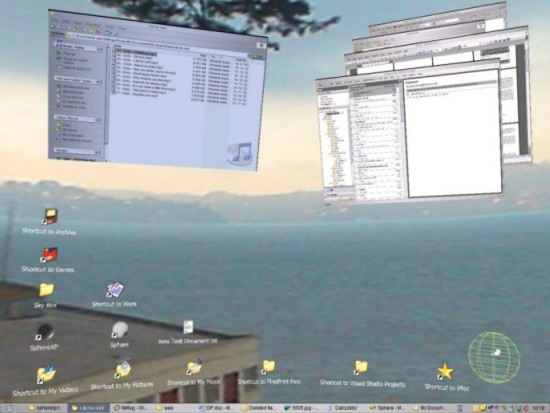
So, 3D desktop is not far away. Though our display devices are going to be 2D for quite a long time, our desktop is going to be 3D for sure. I am certain that it will bring some fantastic and rich experience to us.
Monday, May 08, 2006
The Potential and Challenges of Information Technology for the Future of Bangladesh - Sajeeb Wazed Joy
Here is an excellent article on Bangladesh IT by Sajeeb Wazed Joy. It is nice to see that unlike other illiterate supreme leaders of Bangladesh, who refuses to connect to information superhighway for free in fear of national secret being leaked (how unfortunate we are!!!), he at least understands the problems and solutions of BD IT. I am here assuming that he himself wrote the article. It will be nice if he actually keeps his promises in future.
<Article>
<Article>
Thursday • May 04, 2006
The Potential and Challenges of Information Technology for the Future of Bangladesh
SAJEEB WAZED JOY
As you may know, the Global Information Technology Report 2005-2006, sponsored by the World Economic Forum has been released. According to the report, Bangladesh is marginally improved but going backwards in terms of its ICT development. The report uses the Networked Readiness Index (NRI), covering a total of 115 economies during the year 2005, to measure the degree of preparation of a nation or community to participate in and benefit from ICT developments. The NRI is composed of three component indexes which assess:
1. The environment for ICT offered by a given country or community,
2. The readiness of the community's key stakeholders - individuals, business and governments and
3. The usage of ICT among these stakeholders.
During the year 2004, Bangladesh's NRI score was -1.30, amongst the bottom four Least Developed Countries (LDCs) with rank 100th. In 2005 the score is -1.11, amongst the bottom six LDCs with rank going downward to 110th out of 115.
India now has forty four percent of the global outsourcing market. This is projected to grow to fifty one percent by the year 2008. However, along with this growth comes a problem. Countries such as India are seeing a rise in their cost of labor which gives Bangladesh a second chance at the train we missed the first time. To compete globally Bangladesh must develop its ICT industry. We already have the human resource. What we must have urgently is sufficient bandwidth and a stable supply of power.
During the Awami League's tenure we added over fifteen hundred megawatts of power production capacity. We had projected and planned for a growth of fifteen hundred megawatts of additional power production capacity in the next five years. Since this government has taken over they have added a net of zero megawatts of power production. I'm sure you are all feeling the effects of this. This does not just affect the ICT industry, but every facet of business and development. One simply cannot develop a nation with a shortage of electricity.
The Awami League government also took the first practical steps towards ICT development in Bangladesh. To encourage investment in the software industry we allocated one hundred crore taka in our 2000-2001 budget. We eliminated all import duties on computer hardware, software and peripherals. A desktop computer used to cost three lakh taka. We brought that price down to forty thousand taka. Where there were only ten to twelve thousand computers in use nationwide, now more than fifteen thousand are purchased every month. This has directly benefited all of you. The current government has since reinstated some of those taxes that we had eliminated.
Before our tenure, no government office had a computer. Even our embassy in Washington used a typewriter for all letters to the US Government! We began the process of computerization of all government offices.
During its first term the BNP government was presented with the option of connecting the country to a submarine fiber optic cable at no cost. Unbelievably, they refused this offer. The Awami League government then initiated the current submarine fiber optic cable project. By this time it was no longer an option to connect for free. Still, the project was created but elections were upon us before we could implement it. Then the BNP government came back to power. The project was redesigned. Originally, the plan was to build a cable from Bangladesh all the way to Singapore. This was done because there was no consortium cable under construction at that time through the Bay of Bengal to which we could connect. The project was delayed after the change in government and when it was finally reinitiated, a new consortium cable was under construction. The government chose to connect to this as the cost is shared among the consortium partners. However, the cost of the submarine cable project was subsequently inflated so that now the cable that has been built has cost the same as the originally planned cable to Singapore. The original planned site of the landing station was at Shitakunda in Chittagong but it was moved to Cox's Bazaar. This was done as there was no network link between Chittagong and Cox's Bazaar and so government cronies could make a huge profit building this network link and large kickbacks were paid to Hawa Bhaban.
Under the BNP, corruption has pervaded every sector of the government. The ICT sector has not been spared. Eighteen crore taka of research and development funds have simply disappeared and hundreds of crore taka have been misspent by the ICT Ministry.
The question now is, what do we do going forward? This brief does not purport to be a policy paper for the Awami League, but I would like to present you with some of my ideas. The main purpose of this seminar is to give me an opportunity to meet with all of you who represent the ICT industry in this country and take back some of your ideas and concerns. All of this will then be incorporated into Awami League's future policies.
With regards to power production, the Awami League has an established track record of developing the nation's power infrastructure. We initiated the privatization of power production which resulted in greater efficiency, reduced corruption and rapid growth. These policies will continue and we will build the necessary power production capacity to meet the demands of the entire nation now and into the future.
I also propose to develop e-governance initiatives. Putting government information online, such as budgets and expenditure will bring about transparency and accountability. Creating a nationwide database and network for the police will increase the efficiency of the law enforcement agencies, improve law and order, prevent instances of police abuse and help us fight terrorism. Online citizen processes such as tax filings, land registration, tender and procurement and public grievances along with online payment schemes for all of these will eliminate the scope for bribery and corruption. My goal is that eventually, all citizen transactions with the government can be completed online without you having to wait in line outside multiple government offices for days and bribing everyone from the peon to the secretary to do something as mundane as filing your taxes.
Then we have the issue of bandwidth. It is not enough just to build a submarine fiber optic cable. Bandwidth must reach the entrepreneurs. This requires a massive distribution network within the country. Still, just a network is not enough either. There must be sound policies put in place to regulate the distribution of the bandwidth. The current submarine cable provides Bangladesh with a bandwidth of ten gigabits per second while the current BTTB network can transmit a maximum of two megabits per second. That is barely one millionth of the capacity of the cable. Current BTTB plans do not call for the utilization of the full bandwidth for another four years! Also, the current policies call for the submarine cable to carry only voice traffic for the foreseeable future. That means that most of your businesses will not see any benefit from this cable. Lastly, the current regulatory framework calls for completely non-transparent control over the distribution of the bandwidth. What that means is that kickbacks to Hawa Bhaban will make up the largest portion of the bandwidth pricing. Bandwidth prices will follow the same trend as the price of all essentials in this country have during this government's term and you will pay double of what the actual cost is.
What we need is to build national data backbones and implement a balanced bandwidth distribution policy. What I would like to propose is to completely revamp the existing telecommunications regulatory commission, the BTTRC, making it more independent and transparent. Along with that, I propose allowing private telecommunications companies to build the backbones. From there the distribution network and the last mile solution can be spread out competitively among telecommunications companies and local ISPs. This would free the government of the cost of building the network and allow each locality to develop the solutions most appropriate for it based on the terrain and existing infrastructure.
In the software sector, entrepreneurs must pay more attention to developing local expertise rather than just trying to re-sell foreign software. We should not become just sales offices for foreign IT shops. On the export side one of the areas that appear to need some help is our ability for project management through the whole project. We need to improve our educational institutions and IT curricula to develop this expertise. We also need to initiate computer usage and training earlier, in our schools rather than in colleges.
We also need to think about technology that can change the lives of the common people. Whether that's a new way for the farmer to pump water or alternative fuel for our cars, we need to think of technology not just in terms of telecommunications or software but as a tool to improve our daily lives. This will increase efficiency in every aspect of our lives. I believe that maximum utilization of technology is our shortcut to modernization.
The government has spent millions of dollars setting up IT parks and ICT centers in places such as Silicon Valley. This simply does not work. What we need to do, instead, is to provide the infrastructure and policies and let the private sector, all of your businesses, flourish. I propose to continue the infrastructure development and tax cuts that we had initiated during our previous term. I also propose to set up a venture fund to finance promising IT startups in Bangladesh.
If we make it, it will be because of the entrepreneurs in the private sector, not the government. Microsoft was built by a college dropout. Yahoo was built by two Stanford students in a trailer. Hewlett Packard was started in a garage. We have to find our own Bill Gates and make sure they have the tools to succeed.
Source: http://www.albd.org/compile/2006/it_joy.htm
</Article>
Friday, April 28, 2006
How Google works!!!
Here is an interesting article on how the search giant Google works. The information in the article is provided by Urs Hoelze, Google vice president of operations and vice president of engineering. I found their redundancy theory very interesting and practically useful indeed. They are smart people, actually they must be, otherwise how they could achieve what they achieved :-).
Subscribe to:
Posts (Atom)